

Reaching participants who do not want to be found
Four rounds of research with LGBTQIA+ young people in South Africa and Zimbabwe, testing a mental health service that only works if the people using it feel safe.
CLIENT
SameSame Collective
METHODS
Diary studies
In-depth interviews
co-design workshop
REGION
South Africa and Zimbabwe
YEARS
2023 - 2024
The brief
SameSame Collective is a non-profit that uses mobile technology to support the mental health and wellbeing of LGBTQIA+ young people.
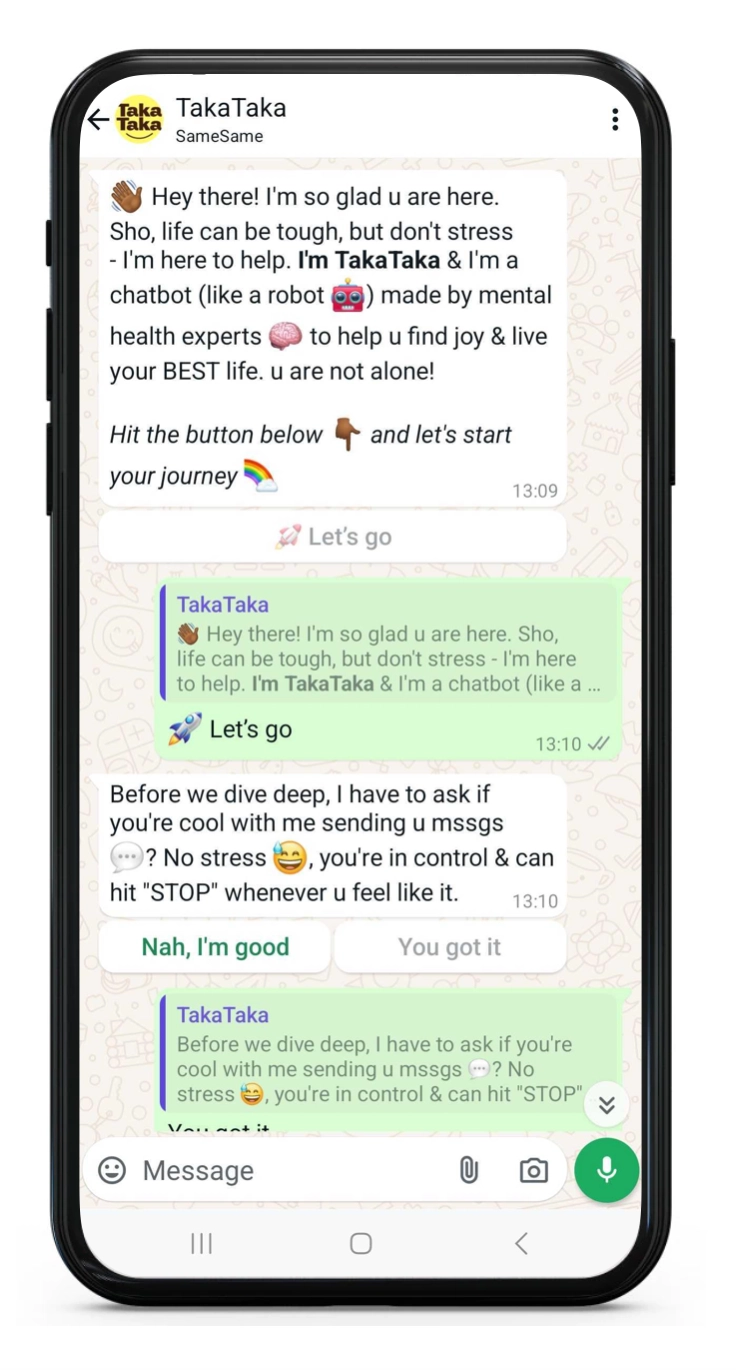
It has developed an eight-session course, delivered through WhatsApp and grounded in cognitive behavioural therapy (CBT), with and for the community it was intended to serve.
SameSame needed to understand how young people experienced the service over time: whether the activities made sense, what participants remembered, what helped them keep going and what caused them to disengage.
This was not a question a one-hour usability test could answer.
The challenge
How might we understand a private, ten-day therapeutic experience without compromising the people taking part?
The challenge was not any single constraint, but how they compounded one another. Participants were difficult to reach and, in many contexts, unsafe to identify. The subject matter was deeply personal, while the service itself was confidential by design.
The course also unfolded over ten days, in brief, private moments. The context around each session mattered. Where someone was, whether other people had access to the phone, and whether they felt safe answering.
Connectivity was unreliable, and the research in Zimbabwe also ran through a deepening power crisis.
To understand the experience properly, the research had to fit around participants’ lives rather than asking participants to fit around a conventional study.
What we did
We acted as SameSame’s extended research team across four related projects in South Africa and Zimbabwe.
Three rounds of research combined WhatsApp diary studies with in-depth interviews and a co-design workshop. The research followed participants through successive versions of the chat activities, focusing on comprehension, recall, and completion.
One of the core diary studies followed 10 participants over ten days:
- Each participant received an individual 15-minute briefing explaining how the study would work.
- Participants spent two days freely exploring the service before completing the eight-session course at roughly one session a day.
- Every two to three days, we asked which sessions they had completed, how they felt about them and what they had or had not found useful.
- Participants could answer by text, voice note or emoji (Whichever was easiest for them).
- At the end of the diary study, we held a one-hour interview and worked through each participant’s research diary with them.
Where it helped participants express themselves more comfortably, interviews switched into Xhosa, Zulu, Ndebele, or Shona. We worked with facilitators who could hold these sensitive conversations carefully and create an environment in which participants could speak openly.
Designing around privacy and safety
Participants used one chat for the SameSame service (FanaFana in South Africa and TakaTaka in Zimbabwe) and a separate WhatsApp conversation with us for the research.
We explained during the briefing that we could not see what they wrote inside the service. During the final interview, screen sharing was limited to the separate research chat. Participants were never asked to reveal their private conversations with the service.
The research prompts also went beyond the interface.
Where were you when you completed the session? Whose phone were you using? Did anyone else have access to it? Were you alone? Did you feel safe? How did you feel about the chat history remaining on the device?
Those were not merely background questions. For a confidential service, the circumstances around the phone were part of the product experience.
Language was the participant’s choice, not the study’s. The response format was flexible too: a detailed voice note, a short message or an emoji could all be useful diary entries. Reducing the effort required to respond helped participants stay involved throughout a ten-day study.
We also set expectations clearly at the start and paid incentives within 12 hours of the final interview.
How it helped
The research ran alongside successive iterations of the chat activities. Each round fed into the next version, giving SameSame evidence about what participants understood, remembered, and completed as well as what affected their willingness to continue.
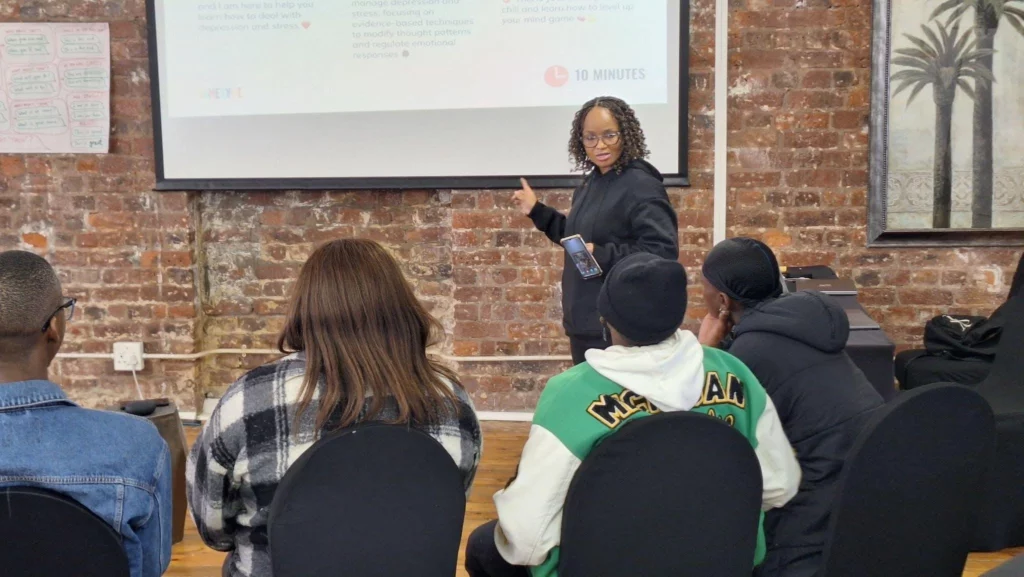
The work did not end with evaluative research. We also handled the participant logistics for and help facilitate a generative co-design workshop in Cape Town, allowing queer youth to work directly on the next version of the service.
It gave the team practical evidence to guide product decisions while respecting the confidentiality at the centre of the service.
This work was not a clinical efficacy study. Its value was in showing how young people understood and experienced the service, and what SameSame needed to consider in the next iteration.
From the founder
"SameSame hired How Might We to complete an almost impossible task - reach out to young queer South Africans who don't want to be found, convince them to answer some potentially sensitive questions, and create an environment that felt safe enough for them to share, honestly and authentically. The team at How Might We delivered. Not once, not twice, but across four different related research projects. Across all of our work together, I was impressed by the team's sensitivity to the needs of research participants and their flexibility as we encountered and solved a variety of challenges."
Jonathan McKay, Founder of SameSame Collective