
The tech landscape has changed in the last 5 years. Specifically in the product development space where the lines between product creation, marketing and engaging with the audience of users has blurred since the beginning of 2020.
We’re seeing the shift is not just about upgraded tech stacks or adopting the next “AI productivity” tool. What’s transforming is the mindset around how we build. One profound change emerging is the crowd-sourced approach to building digital products.
Product creators are embracing their audiences more and more. Creators and founders aren’t waiting until launch day to reveal what they’re building; they’re doing it live. Audiences are no longer seen as passive followers, they’re collaborators, advisors, and early adopters who are shaping ideas in real time.
Social media platforms, once designed for entertainment and promotion, are now valuable sources of validation. The stealth era of closed betas and carefully timed launches seems to be fading.
The question is no longer only what are we building, but how are we building it, and who are we building it with.
Product creation is becoming a more public process
Product development used to happen behind closed doors. Startups followed a familiar formula: identify a problem, validate it, build a solution, and scale. Validation was limited to surveys, dashboards, and structured beta programs. But content creators have had a different idea. They saw the potential to get the user involved in ideation and testing much earlier on, using social media as a real-time innovation lab.
Feedback doesn’t come exclusively from beta testers anymore, it comes from the collective creativity of communities; followers, comment sections, and DMs. What started as “just posting” updates has evolved into a new form of live research and development.
Communities are effectively co-designing what digital products get made, how they evolve, and which ideas are worth pursuing, all through their social feedback.
Social media turns validation into action
After creators validate their ideas on social media, they already have the marketing message and community to buy into their ideas.
According to LTK’s 2024 shopper study 1 84% of consumers are more likely to trust brands featured in creator content. What once took months of market research can now happen in a 60-second video. A 2021 study showed that 49% of TikTok users made purchases 2 after seeing a product mentioned on the platform.
User-generated content (UGC) acts as a trust engine.3 Nearly 8 in 10 Millennials and 7 in 10 Gen Z say they’re more influenced by real people online than by traditional ads.
Connecting with an audience is a powerful product launchpad
Influence used to be about reach, but now it’s about relatable creators and how they connect with their audience. According to Deloitte 3, creators who produce niche, authentic content outperform broad influencer campaigns precisely because they feel human because audiences become a community rather than just consumers or users of products.
For example, Cluely didn’t just begin with a clever idea; it began with a relatable conversation.
When Chungin “Roy” Lee, then a Columbia student, publicly challenged the value of LeetCode-style interviews and built an AI bot that could “cheat” coding tests in real time, he wasn’t trying to start a company. He was responding to a frustration many developers had been voicing for years.
The post he shared challenged technical interviews, and it struck a nerve. Thousands of people jumped into the comments, sharing and debating over their own experiences and hiring ethics. This pushed the topic far beyond the initial controversy. He used that momentum to create Cluely, an AI assistant that helps users think faster in meetings, interviews, and daily work. Proving that controversy can be a powerful product launch strategy.
What does the new playbook mean for user research?
The new world of creator-led validation is public, social, and immediate. Which is infinitely more tempting as a research method compared to the way the traditional development processes are considered (more data-heavy and delayed traditional validation of digital products in markets).
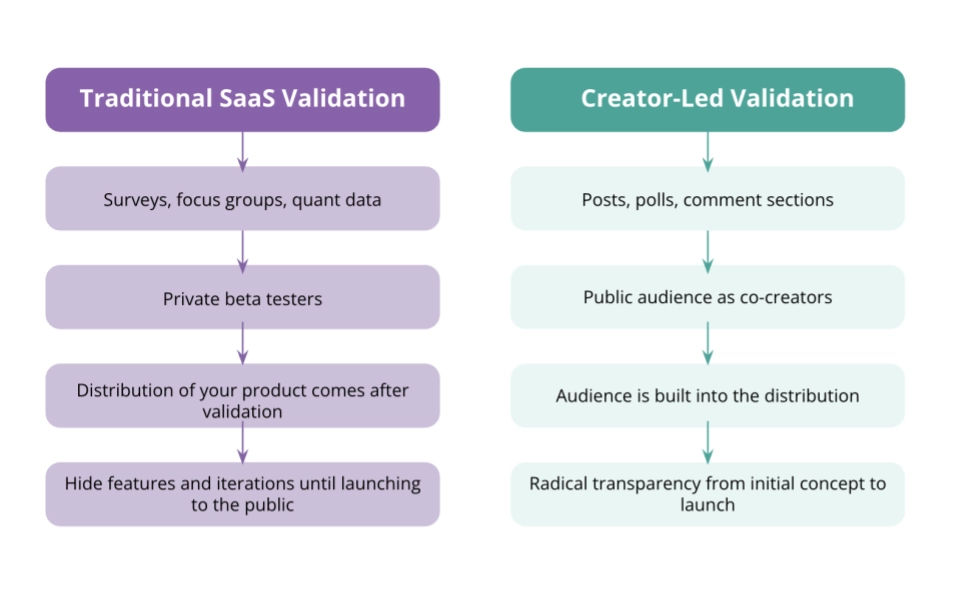
While we, as UX Researchers, find social commentary an incredibly valuable source of data to understand user sentiment at scale, it’s no match for good old usability testing and quant data. It’s important to see that it’s still not the same as quantifiable and theoretically tested frameworks like surveys, focus groups and usability tests. These methods hold value because the methodology behind them makes the data valid. Keep an eye out for our upcoming blog, Why small data can still be mighty where we unpack this topic a bit more.
Building in public is essentially participatory design scaled up, and made more accessible. It’s useful for generating ideas and making sense of user needs, but should be cautiously approached as true validation method. Like focus groups, it’s prone to dominant voices, and because participants self-select, the bias can be even stronger.
As always, know your users
As everything around us continues to shift, one thing becomes more important than ever: listening to your audience. Because even as tools and platforms evolve, the heart of product building remains the same. The closer we stay to the people we serve, the better and more meaningful our products become.
Listen to your users today through UX research.
Sources:
- Adweek (2021) Nearly Half of TikTokers Are Buying Stuff From Brands They See on the Platform. Available at: https://www.adweek.com/brand-marketing/nearly-half-of-tiktokers-are-buying-stuff-from-brands-they-see-on-the-platform/
- Social Targeter (2025) Exploring the Psychological Impact of UGC on Gen Z Purchasing Decisions. Available at: https://www.socialtargeter.com/blogs/exploring-the-psychological-impact-of-ugc-on-gen-z-purchasing-decisions
- Deloitte (2024) What’s the Difference Between Creators and Influencers? Available at: https://deloitte.wsj.com/cmo/whats-the-difference-between-creators-and-influencers-f68c026c
- MartechVibe (2025) Creators Witness Increased Trust Amongst Young Shoppers. Available at: https://martechvibe.com/article/creators-witness-increased-trust-amongst-young-shoppers/